Introduction
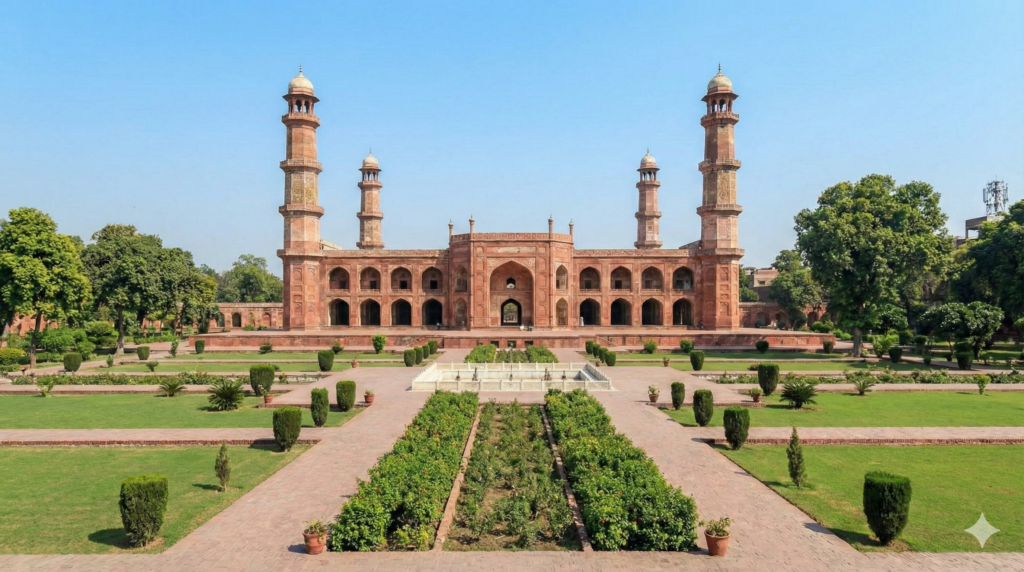
The Tomb of Emperor Jahangir is a major Mughal-era monument located in Shahdara Bagh, Lahore, on the banks of the River Ravi. It is one of the finest examples of Mughal funerary architecture and a landmark of Pakistan’s cultural heritage.
Background of Emperor Jahangir
Jahangir, the fourth Mughal emperor (reigned 1605–1627), was known for his passion for nature, architecture, and the arts.
After his death in 1627 in Kashmir, his body was transported to Lahore, a city he deeply admired.
His burial site was chosen in the royal gardens of Shalimar’s outskirts, where he often stayed with Empress Nur Jahan.
Construction History (1627–1637)
Construction of the tomb began shortly after Jahangir’s death.
The project was supervised primarily by Empress Nur Jahan, his wife, along with his son Shah Jahan.
Completed around 1637 during Shah Jahan’s reign.
The site was originally Nur Jahan’s private garden, known as Dilkusha Garden.
Architectural Features
1. Layout and Design
Built on a raised platform in a square enclosure.
Follows the traditional charbagh (four-part garden) layout with symmetrical pathways and water channels.
2. Exterior Design
Constructed with red sandstone adorned with white marble inlay, following Shah Jahan-era style.
Features four elegant minarets, one at each corner of the mausoleum—uncommon in earlier Mughal tombs.
3. The Mausoleum Structure
Unlike many Mughal tombs, the Tomb of Jahangir does not have a central dome.
This design choice is widely attributed to Nur Jahan’s aesthetic preference for flat-roofed structures and the site’s garden-style character.
4. Interior Decoration
Interior walls feature:
Pietra dura floral designs
Intricate frescoes
Geometric and natural motifs
The white marble cenotaph is decorated with Quranic inscriptions and delicate motifs depicting grapes and wine cups, symbolizing Jahangir’s fondness for horticulture and Persian art.
Historical Timeline
Mughal Era
Served as a majestic memorial and a major stop for royal processions.
The adjoining structures—Akbari Sarai and Asif Khan’s tomb—formed a royal funerary complex.
Sikh Period (1799–1849)
The tomb suffered heavy damage during the Sikh Empire under Maharaja Ranjit Singh.
Decorative elements, including precious stones and furniture, were removed.
The site was temporarily used as a cantonment.
British Colonial Period
The British took control in 1849 and stabilized the structure to prevent collapse.
Restoration efforts were initiated but remained limited and utilitarian.
Post-Independence Pakistan
Significant conservation and restoration began after 1947 by the Department of Archaeology.
Major improvements included:
Restoration of fresco paintings
Stabilization of minarets
Rebuilding garden pathways and water channels
Today, the tomb is protected as a national heritage site.
Cultural and Architectural Significance
Considered one of the most beautiful Mughal tombs after the Taj Mahal.
A unique architectural blend of:
Persian influences
Shah Jahan-era decorative arts
Garden-tomb traditions
Serves as a major tourist attraction and a symbol of Lahore’s cultural legacy.