Introduction
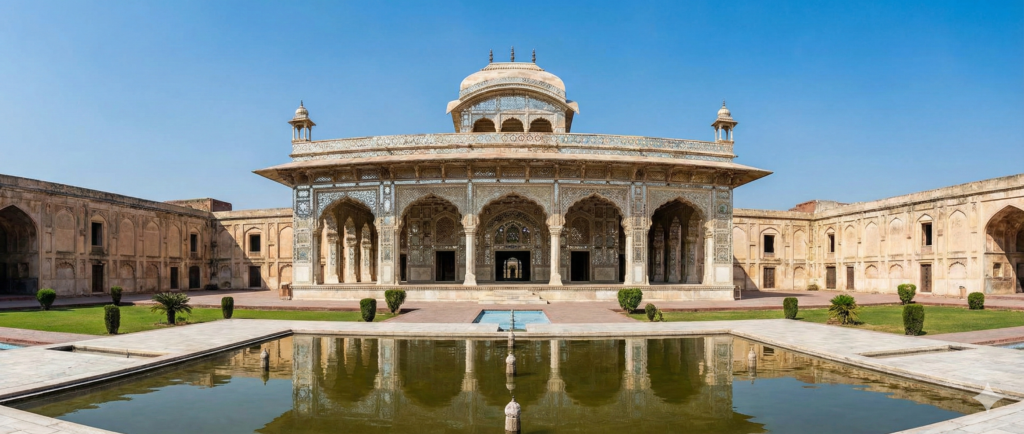
Sheesh Mahal (Palace of Mirrors) is one of the most exquisite and celebrated structures within the Lahore Fort, Pakistan. It represents the artistic peak of Mughal craftsmanship, known for its intricate mirror work, marble reliefs, and pietra dura ornamentation.
Construction Period (1631–1632)
Built during the reign of Mughal Emperor Shah Jahan, the same emperor who built the Taj Mahal.
Constructed under the supervision of Asif Khan, Shah Jahan’s trusted noble and brother-in-law.
Located in the northern-western corner of the fort, part of the private royal residential area.
Architectural Design
1. Mirror Work (Sheesh Kari)
The hallmark feature is the elaborate mirror-mosaic work using tiny convex mirrors.
Craftsmen used a technique called Ayina Kari, embedding fine mirror pieces into stucco to reflect candle or torchlight, creating a glowing “starry sky” effect.
2. Pietra Dura & Marble Inlay
Extensive use of white marble, carved with floral patterns.
Precious stones and colored glass were used for pietra dura, similar to designs in the Taj Mahal.
3. Royal Private Chamber
Sheesh Mahal was part of the Shah Burj (King’s Pavilion), reserved exclusively for the emperor’s personal use.
Served as a pleasure pavilion and resting chamber, with access restricted to the imperial household.
Historical Significance
Mughal Era
Functioned as a luxurious royal space for Shah Jahan and later Mughal emperors.
Known for hosting private gatherings, royal queens, and distinguished guests.
Its reflective interior was designed to enhance the luminosity from candles and lanterns.
Sikh Period (1799–1849)
During Maharaja Ranjit Singh’s rule, the palace was heavily used and altered.
The central throne platform was repurposed by Ranjit Singh for ceremonial events.
Some decorative pieces and jewels were removed during this era.
British Colonial Period
Facing decay by the mid-19th century, the structure was partly damaged due to neglect.
Restoration efforts began under British supervision, though methods were not always historically accurate.
Post-Independence Restoration
After 1947, Pakistan’s Department of Archaeology launched extensive conservation projects.
In 1981, Sheesh Mahal and the entire Lahore Fort were declared UNESCO World Heritage Sites.
Recent conservation has focused on:
Stabilizing mirror work
Strengthening the roof
Preserving mural paintings
Cleaning pietra dura surfaces
Cultural Importance Today
Considered one of the finest Mughal mirror palaces in the world.
Attracts millions of visitors annually as a centerpiece of Lahore’s heritage.
Symbolizes the artistic luxury, sophistication, and craftsmanship of Mughal architecture.